Enabling / Disabling L7 API Dissection
Compute resource consumption, especially CPU and memory, is critical in Kubernetes environments. Kubeshark’s L7 API dissection consumes significant compute resources as it processes and analyzes network traffic. There are two primary ways to manage resource consumption:
- Enable/Disable API Dissection - Toggle dissection on or off entirely (described on this page)
- Capture Filters - Reduce the number of workloads being dissected to lower resource usage
Enabling or disabling API dissection directly controls Kubeshark’s compute resource usage. When dissection is paused, Kubeshark remains in a dormant state within the cluster—not processing traffic and consuming minimal compute resources.
Kubeshark’s Helm template includes a Helm value, tap.capture.stopped, that determines whether Kubeshark starts in a stopped state.
Changing the Value Dynamically
There are multiple ways to toggle dissection at runtime:
Via the Dashboard
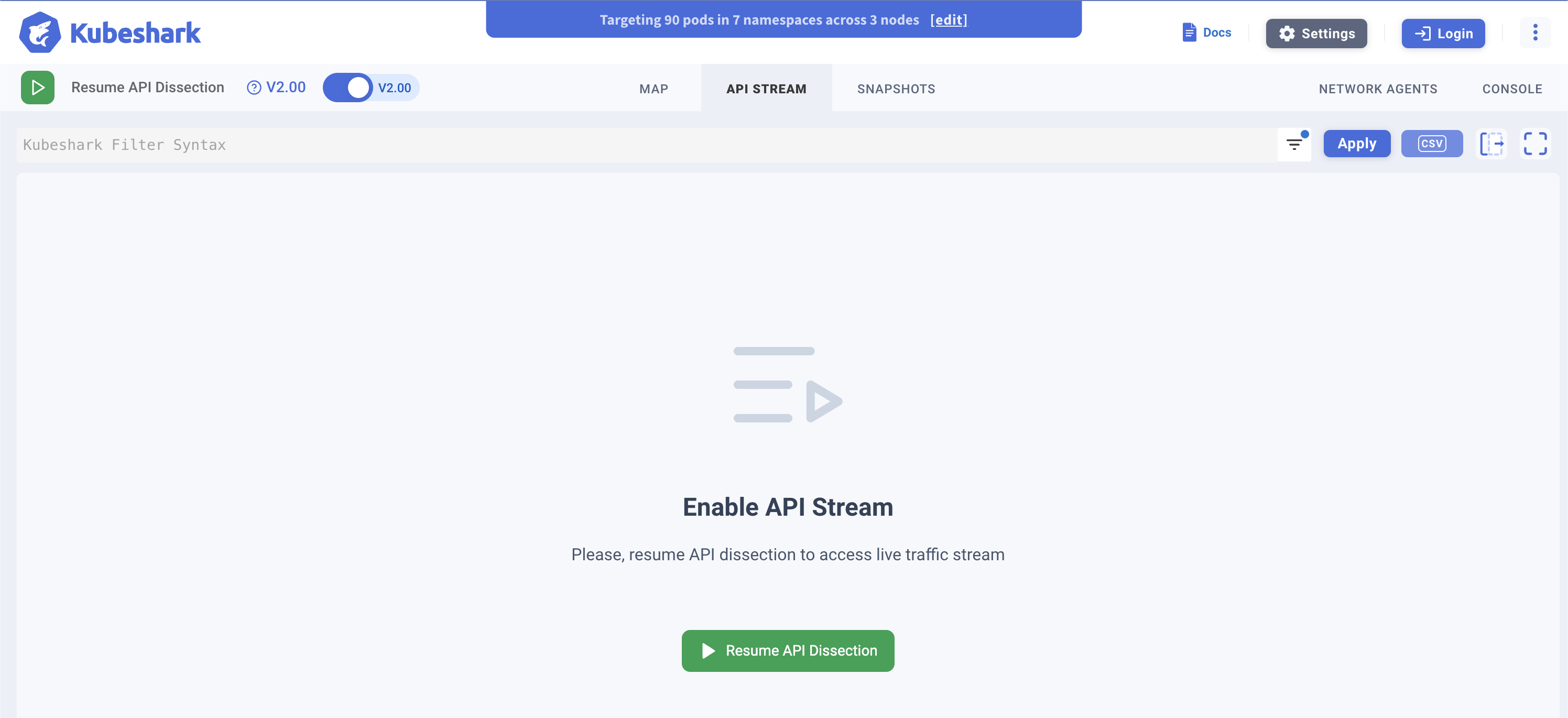
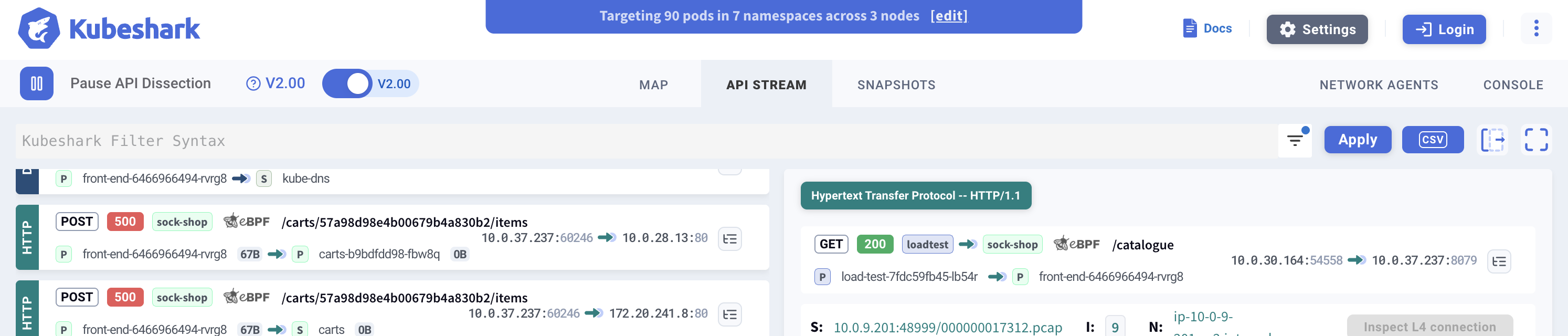
This setting can be updated in real-time through the dashboard by clicking the API Dissection button in the top-left corner. The button has two states:
When API dissection is paused - A green play button labeled “Resume API Dissection” is displayed:
When API dissection is active - A red stop button labeled “Pause API Dissection” is displayed:
Via MCP Endpoints
AI assistants can control dissection programmatically through the MCP server:
| Endpoint | Method | Description |
|---|---|---|
/mcp/dissection | GET | Get current dissection status |
/mcp/dissection/enable | POST | Enable L7 protocol parsing |
/mcp/dissection/disable | POST | Disable L7 protocol parsing |
Check status:
curl http://localhost:8898/mcp/dissection
# {"enabled": true}
Enable dissection:
curl -X POST http://localhost:8898/mcp/dissection/enable
# {"success": true, "enabled": true}
Disable dissection:
curl -X POST http://localhost:8898/mcp/dissection/disable
# {"success": true, "enabled": false}
See L7 Tools Reference for more details on MCP endpoints.
Using a Helm Value
Setting --set tap.capture.stopped=true ensures Kubeshark starts in a dormant state, ready to begin API dissection once the value is changed to false.
To have Kubeshark perform API dissection continuously, set the flag to false either via command line:
--set tap.capture.stopped=false
or in the values.yaml file:
tap:
  capture:
    stopped: false
    stopAfter: 5m
Inactivity Timeout
The tap.capture.stopAfter Helm value automatically pauses API dissection and transitions Kubeshark into dormant mode when no activity is detected. By default, this timeout is 5m (5 minutes).
Activity is defined as one of the following:
- At least one dashboard session open with streaming enabled
- An active traffic recording
- An active Network Agent
If none of these conditions are met, Kubeshark will enter dormant mode after the specified period.
Important: If you want API dissection to run continuously without automatic timeout, set
tap.capture.stopAfter: 0. Otherwise, API dissection will automatically pause 5 minutes after the last dashboard disconnects.
To disable inactivity-based dormancy:
tap:
  capture:
    stopAfter: 0